
The Compression Error
Professor Jan Rosenow argues that electrification shrinks Europe's energy problem. The shrinkage is real on paper — and fails because it comes entirely from leaving the hard part out of the sum.

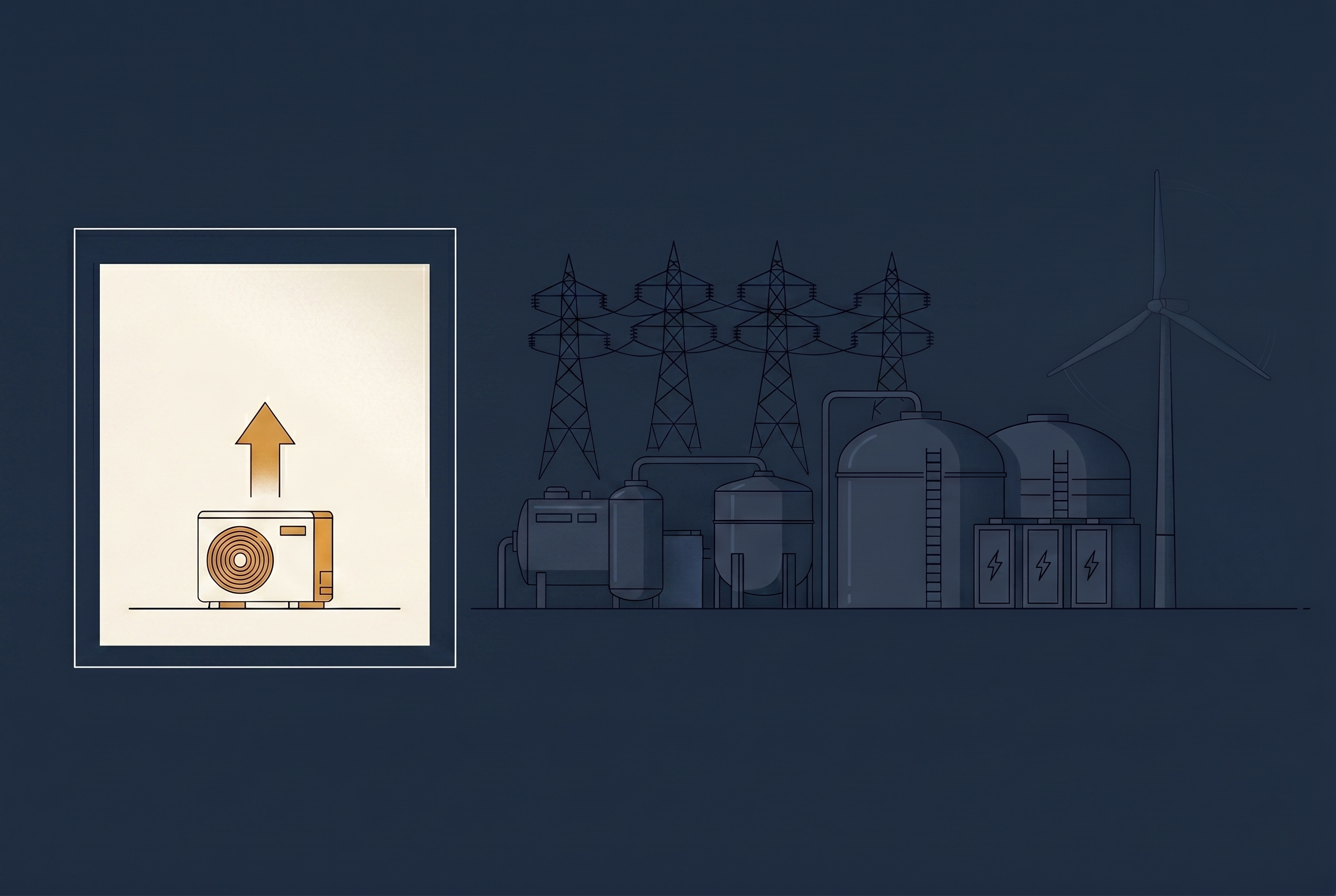
THIS WEEKEND Professor Jan Rosenow published a piece arguing that Europe’s best defence against the next energy price shock is the energy it has already learned not to use. Efficiency, he writes, has quietly saved the continent a third of its energy since 2000. Electrification will save more, because electric machines waste less than the ones they replace. Treat efficiency, electrification and clean power as one system rather than three rival lobbies, and most of the road to energy security is simply a matter of delivering what is already agreed.
It is the most sophisticated version of the case for the renewable transition now in public circulation, which is exactly why it is worth taking apart. The whole argument rests on a single idea, and he names it himself: system compression. The claim that an electrified economy delivers the same services with far less total energy, so that the problem we are trying to solve is not as large as it looks — it is, in his word, getting smaller.
The idea is wrong. Not roughly right with caveats — wrong at its foundation, in a way that takes the rest of the argument down with it. And because the same move runs underneath almost everything written in favour of a renewables-led transition, it is worth being precise about where it fails.
First, the man — because it matters less than you think
Professor Rosenow is not a marginal figure. He has an Oxford chair, a research fellowship at Oriel, more than 150 peer-reviewed papers, a place in the most-cited two per cent of scientists, and a public platform — some 190,000 followers — larger than that of most government departments. He has briefed all 27 EU energy ministers and spoken at Davos. When he writes, hundreds of thousands of people read it. None of that is in dispute, and none of it is to be sneered at. He has earned his audience.
It is precisely because of that reach that the next two facts are worth stating plainly, without heat.
The first is his training. His first degree is in geosciences, his master’s in environmental policy, his doctorate in the politics of energy-efficiency policy. These are real qualifications, honestly held. And none of them is in engineering, physics, thermodynamics or economics — the four disciplines in which the claim he is actually making lives or dies. Compression is a thermodynamic argument with an economic tail. It is not a policy argument. A man can be a distinguished professor of energy policy and still be making a claim outside his field.
This is not really a point about one man. A central theme of my book is who now makes and argues energy policy: a field thick with people trained in policy and advocacy, and far thinner in the engineering, physics and economics that decide whether a plan survives contact with the physical world. Professor Rosenow is a distinguished instance of the pattern, not an exception to it.
The second is who has paid for the work. For most of his career Professor Rosenow was European programme director of the Regulatory Assistance Project, and he remains an adviser to it. RAP is registered in the EU Transparency Register as an organisation that lobbies the European institutions, and among its principal funders is the European Climate Foundation, a philanthropy whose declared mission is to drive the transition to net zero. His Oxford fellowship, too, is funded by an environmental trust. In other words, he has been paid throughout by institutions whose stated purpose is to advance the very policies he advocates.
I want to be careful here, because it would be easy to misread. I am not suggesting this has shaped his conclusions. I assume it has not, and I would defend him against anyone who said otherwise. I raise it for one reason only. It is one of the most reliable moves in this debate: when a sceptic raises a doubt, he is told the doubt is bought — fossil-funded, Koch-backed, Exxon-linked — and the argument is treated as answered. A small industry, from Merchants of Doubt to DeSmog’s standing register of ‘climate disinformers’, exists to read a man’s conclusions off his cheques. Very well. If we are going to weigh arguments by who funds them, the scale has to swing both ways: the advocate’s funding is then exactly as relevant as the sceptic’s, and his is a great deal easier to document. But the honest course is to throw the whole apparatus out, on both sides, and do the thing he and I both say we prefer. Check the arithmetic.
So let us.
The trick of the boundary
Concede the machine first, because it is true. A heat pump really does deliver three or four units of heat for each unit of electricity. An electric motor really is more efficient than a petrol engine, which throws away most of its fuel as heat before the wheels turn. At the point where the energy is used, electric end-uses waste far less than the combustion they replace. I have never met a serious sceptic who disputes this, and I do not dispute it. The book I have written concedes every word of it — indeed my own rule, set out there, is to electrify everything that can be electrified, and nothing else. The argument here is not against electrification. It is against the claim that electrification makes the problem of supply disappear.
Here is the move that does the damage. Every one of those efficiency figures is measured at the point of use, and every one of them quietly assumes that the electricity is already there — firm, on demand, at the instant it is called for. The heat pump’s coefficient of performance assumes the kilowatt arrives when the cold snap does. The figure for the share of power that is now ‘almost three-quarters non-fossil’ is an annual average. The compression is computed against a supply that is simply taken as given.
But making that supply be there — turning a variable, weather-dependent flow into something that behaves like a fuel you can burn when you choose — is the entire problem the transition has to solve. And it is the one term that never appears in the compression sum. Professor Rosenow counts the energy that efficiency saves. He even counts, to his credit, the power stations and pipelines that efficiency means you never have to build. He does not count the storage, the overbuild, the standby plant and the grid that electrifying heat and transport forces you to build and keep idle for the worst hour. The ledger runs one way only.
Think of the air you breathe. A body that draws more oxygen from each breath is more efficient — and it tells you nothing about whether there is air in the room. Efficiency works on the lungs. What kills you is the air running out, and making sure it never does is the hard part. Professor Rosenow’s ‘compression’ is a long, elegant study of the lungs.
The arithmetic he leaves out
This is not a sceptic’s hunch. The size of the omitted term has been put on paper by people who want the transition to succeed.
The Royal Society — no nest of deniers — modelled what it would take to run Great Britain on wind and solar. Because wind varies not just hour to hour but across whole years, it found the country would need long-duration storage of the order of a thousand times today’s pumped hydro: tens of terawatt-hours of hydrogen held in salt caverns, built and maintained for the rare bad year. The round-trip losses in storing and recovering that energy then force you to overbuild the wind and solar on top, to fill the store as well as meet demand. On the bill, the Society was blunt: electricity delivered through storage will cost ‘many times’ the wind and solar fed straight into the grid, the scale is ‘far more than could conceivably be provided by conventional batteries’, and ‘no low-carbon sources can do so at a comparable cost’. None of that energy, capital or land is in the compression denominator. Put it back, and the problem does not shrink. It changes shape and explodes.
And almost none of it has reached the bill yet. The subsidy clock I created already totals, to the pound, what the transition has cost Britain so far — a figure now in the hundreds of billions. The storage, the overbuild and the grid the Royal Society describes have barely begun to appear on it. The expensive part of the compression argument is the part still to be charged.
The same charge has been made in pure cost terms by Dieter Helm, who is no sceptic either: the published price of wind and solar excludes the cost of the firm power that stands behind them, so the system bill is far larger than the generation bill. And in pure energy terms, studies that put firming inside the boundary — counting the storage and over-capacity needed to make the output usable — find the net energy returned by wind and solar roughly halves. Three different disciplines, the same finding: the hard part has been left outside the line.
And here is the quiet admission. Read Professor Rosenow’s own essay to the end. Having spent it arguing that the problem is getting smaller, he closes by conceding that ‘the weak link in all this’ is the grid — that clean generation and new demand are arriving faster than the wires to carry them, that connection queues have become ‘a genuine brake’, that ‘grid investment and permitting still need to move up a gear’. That is the omitted term walking back in through the last door in the house. The cost of delivering variable power where and when it is needed did not vanish. It was deferred to the final three paragraphs and renamed. An argument cannot have it both ways: the problem is either compressing, or the system that delivers it cannot keep up. It is the second.
Domestic is not the same as dependable
There is a deeper reason the security claim fails, and it is worth ending on. Professor Rosenow defines energy security as freedom from imports — energy that ‘a supplier you do not control’ can withhold or weaponise. Fair enough as far as it goes. But security has a second axis he never mentions: whether the energy is there when you need it. A grid that is one hundred per cent domestic and cannot deliver through a cold, still, dark week in January has not removed the risk. It has swapped a supplier it cannot control for weather it cannot control. Electricity Europe can make at home is not the same thing as electricity Europe can have on demand, and only the second keeps the lights on.
This is why the averages matter. No power system is sized by its annual mean; it is sized by its worst hour. ‘Three-quarters non-fossil across the year’ tells you how the system behaves when it is working. It tells you nothing about the windless fortnight when electrified heat, electrified transport and electrified industry all pull at once and the turbines stand still. That hour has to be covered, in full, by something. Efficiency does not cover it. Compression does not cover it. Only firm capacity covers it, and firm capacity is the thing the argument is built to look past.
Why this matters beyond one essay
I have spent this long on a single article because the compression move is not Professor Rosenow’s alone. It is the load-bearing rhetorical device of the entire case for a renewables-led transition: choose the system boundary that makes the hard part disappear, measure efficiency inside it, and present the result as though the problem of supply had been answered rather than assumed away. It is fluent, it is counterintuitive, it flatters the reader with a number that feels like insight — and it is incomplete in a way that a non-specialist audience has no easy way to see. That is what plausible advocacy dressed in academic clothing looks like. Not dishonesty. A genuine argument, made with real authority, that happens to be drawn around the wrong boundary.
My book, The Energy Trap, is in large part about that boundary — about what a serious energy accounting has to include, and what the transition looks like once you put the firming back in the sum. It is published by Swift Press in September.
In the meantime, I would be glad to put this to Professor Rosenow directly, in public, on a stage of his choosing. He has a large platform and a confident case; so do I, and I would gladly let our readers watch us test both — on the one condition we should both welcome: that we leave the funding at the door and check the arithmetic.
There is, however, an obstacle. Professor Rosenow has blocked me on Twitter, so for now I have no way of reaching him with the invitation. I will leave readers to judge what it means when an argument this confident declines to be questioned in public. The offer stands the moment he lifts the block.

Richard Lyon writes State of Britain. His book, The Energy Trap: Why the Renewable Energy Transition Can’t Work — And What Can, is published by Swift Press on 24 September and is available for pre-order.
Excellent article! I would forward a link on X to Dr. Rosenow, but he has blocked me. The advocates for the "Energy Transition", especially the academic advocates, do not like having the logic of their advocacy challenged.
The electricity prices will continue to rise, and electricity consumption will continue to fall. The Clean Energy advocates will claim the reduction in power consumption is from greater efficiency, but the reality is the reduction is from demand destruction. Britain is being disabled, Britain is being impoverished, Britain is being de-industrialized. The grid will become more fragile, but the Clean Energy advocates will point to statistics showing just how much plant food has not been emitted.
The wind and solar droughts will surely come. In modern societies, power must be available when it is demanded, in the exact amount of the demand, for the exact duration of the demand, in the exact location of the demand, in the exact voltage and frequency of the grid.
The chaotic spasms of energy thrown into the grid by wind and solar junk energies will never provide the power needed to power modern societies. Take this example from Australia...across the entire continent of Australia, the hopelessly weather dependent impoverishing idiocies of wind and solar could only provide 2.78% of Australia's electricity needs.
https://x.com/LofayPeter/status/2069695908640587983
Great great essay Peter, I think you have nailed what is wrong with the nonsensical intermittent energy transition. I would love the debate in public, but I suspect this expert wouldn’t dare do this. He would not preaching to his ideological, virtue signalling hypocritical congregation. Can’t wait for your book.