
Flying Blind
Britain’s 2050 electricity system has been modelled, costed and legislated around. Nobody has tested whether it runs. It doesn't.

ON 23 JUNE Britain’s grid came far closer to failing than most people realise, and on Kathryn Porter’s account published last week, control-room engineers described themselves as flying blind for want of adequate modelling. One called a major blackout “an engineering certainty”.
Two quite different things go by the name of modelling the grid: choosing a system, and operating one. Only the second was in that room. A simulator operates. It asks what happens in the next five minutes, with the real network circuit by circuit, the sudden loss of the largest infeed, inertia, frequency, plant that fails at the rate plant actually fails. It chooses nothing. It tests whether the system in front of you survives a specific insult.
An optimiser chooses the system itself, and what it produces is a “decarbonisation pathway”, a phrase few could define if pressed. It is a shopping list. It says what Britain should buy — so much offshore wind, so much solar, so many gigawatts of something firm behind them — to reach a carbon number at least cost. Its question is what to build, not whether the thing survives a Tuesday.
A great many bodies produce these, and they are all wildly different: NESO’s scenarios are deliberately divergent and not forecasts, Clean Power 2030 is a commitment government has made, the Climate Change Committee’s is a least-cost route to an emissions target. Behind them stand the universities, the consultancies and the departments.
In fairness, the Committee’s power-sector work is not crude. It is done for them by AFRY on a model called BID3, which runs hourly or finer, splits Britain into regions, samples plant breakdowns stochastically, computes a loss-of-load expectation, and is the tool the energy department uses too. The Committee stress-tested it against a thirty-day wind drought with no historical precedent. Anyone telling you the CCC ignored the weather has not read the methodology.
The gap is somewhere else, and stranger. What gets published is a fleet and a cost, but never an operability verdict. When NESO wanted to know whether their 2030 system would actually run, it published a whole annex on operability: inertia, stability, restoration, constraint management.
Nobody has done it for the 2050 fleet.
Nor can you go and look for yourself. Of the seventy-six energy models the UK Energy Research Centre counts in Britain, about half publish no open information at all and only a sixth are open source. You are invited to trust the estimate and forbidden to inspect it.
Which is one of the reasons I built GridSim. It is a simulator, not an optimiser: it chooses nothing, and asks the control room’s question of a grid that exists only on paper. It runs Britain half-hour by half-hour across forty years of real weather, 1985 to 2024, with interconnectors and internal transmission constraints in place rather than assumed away, and it publishes its scenarios, data, code and its own weaknesses — which include no plant-outage model, and most of which flatter the pathway rather than damn it.
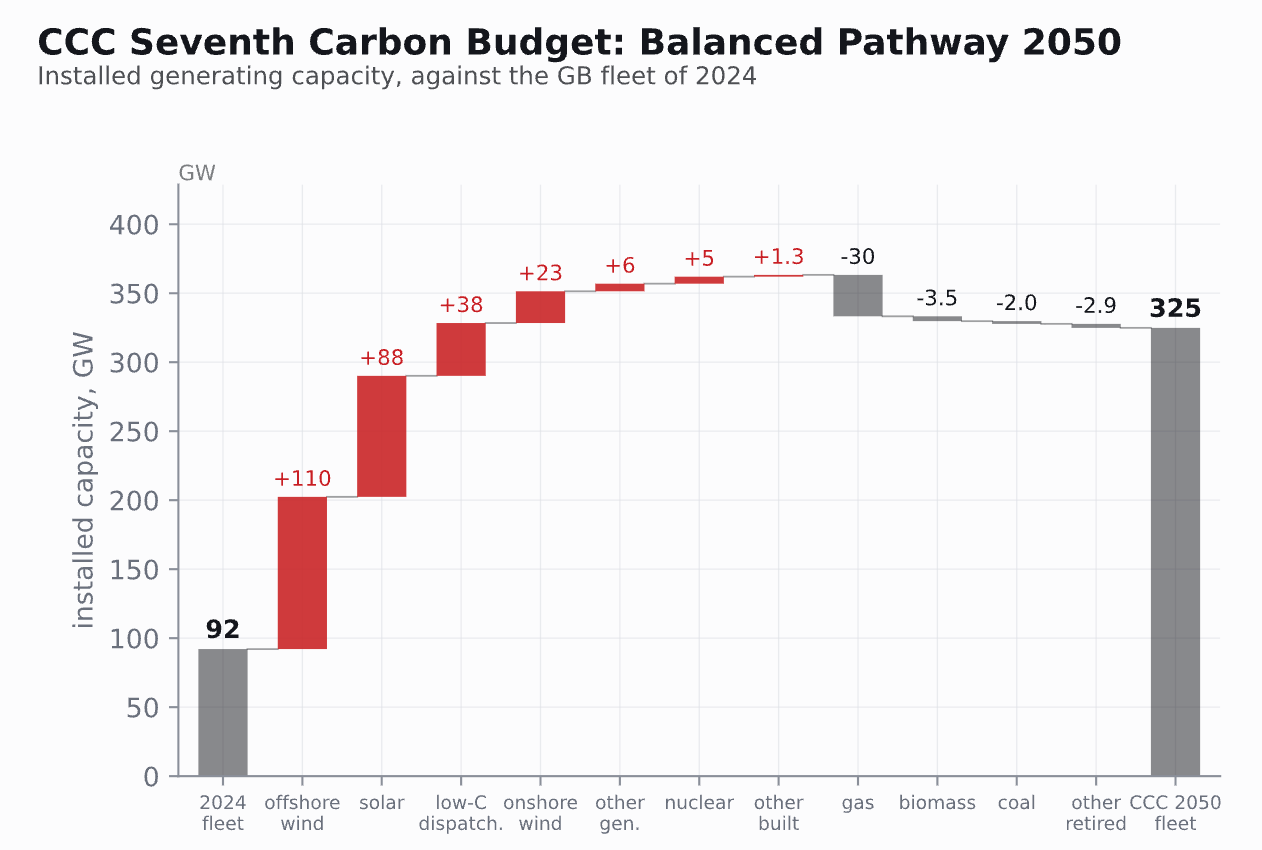
The obvious thing to put through it is the Committee’s 2050 Balanced Pathway, and it is not one picture among many. It is the work of the government’s statutory climate adviser, it is the fleet drawn to satisfy the budget Parliament has just made law, and it is what the network plans and the connection queue are shaped around: some ninety-five gigawatts of offshore wind by 2050, and about thirty-eight gigawatts of firm low-carbon plant the Committee declines to split between gas-with-carbon-capture and hydrogen. Its claim for that fleet could not be plainer — nuclear, dispatchable plant, batteries and interconnection together will ensure reliable supply ‘even in adverse weather years’. That is a testable sentence.
It does not survive the test. Run the fleet against all forty years with cold driving demand rather than only wind driving supply and it comes up short in every single one of them, and not by a whisker: across the record the demand it cannot serve totals 1,751 terawatt-hours, 79 of them in the worst single year. Hand it its own assumed flexibility, better turbines and full firm interconnection, and some 495 terawatt-hours of that shortfall remains. What fails is the firm plant. Peak demand climbs past 185 gigawatts, the thirty-eight gigawatts of dispatchable capacity runs flat out, and there is nothing behind it.
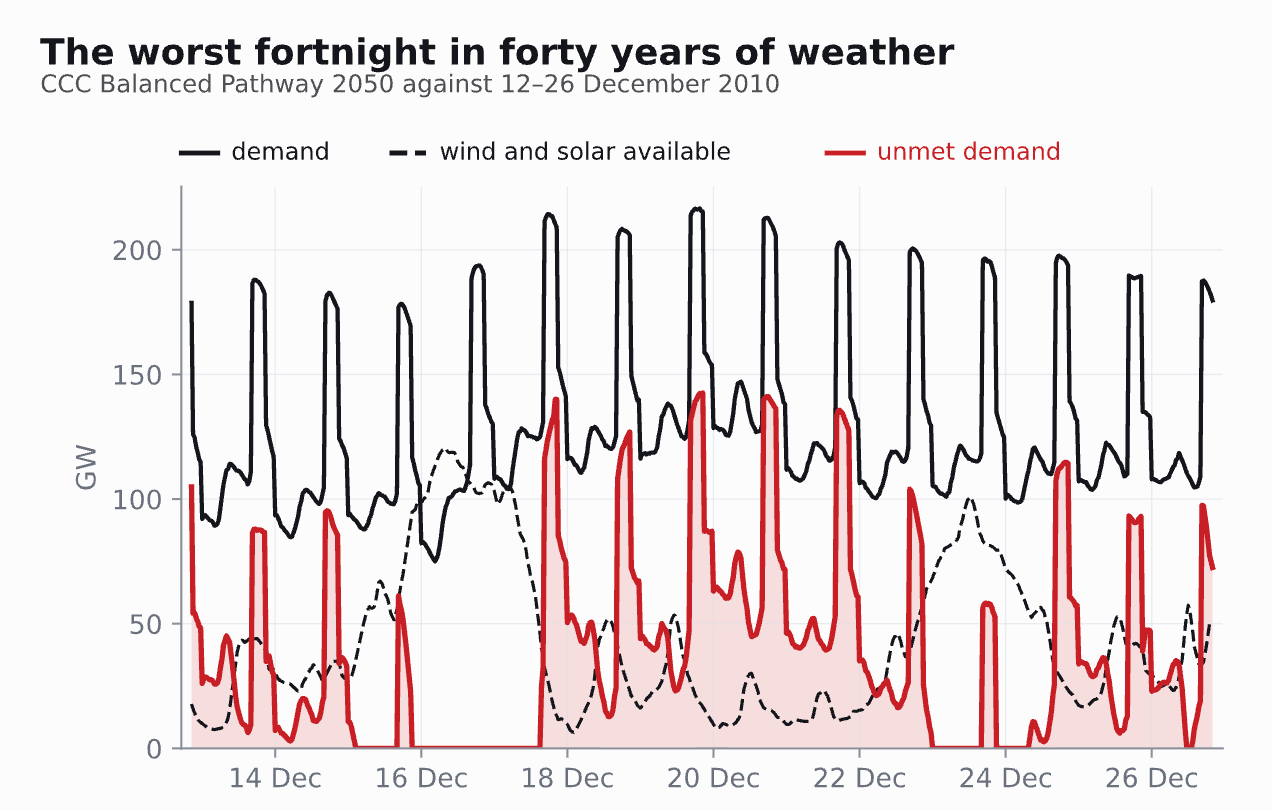
The worst of the forty years is 2010, the winter a long freeze drove heating and vehicle demand to a record while the wind dropped away. Its peak is the most valuable lesson. That peak is 217.8 gigawatts if electric cars charge when people get home, and 185.3 if charging is managed overnight: a 32.5 gigawatt swing, dwarfing Britain’s nuclear ambition, resting on a guess about what people do at six in the evening. No published pathway tells you which guess it has made.
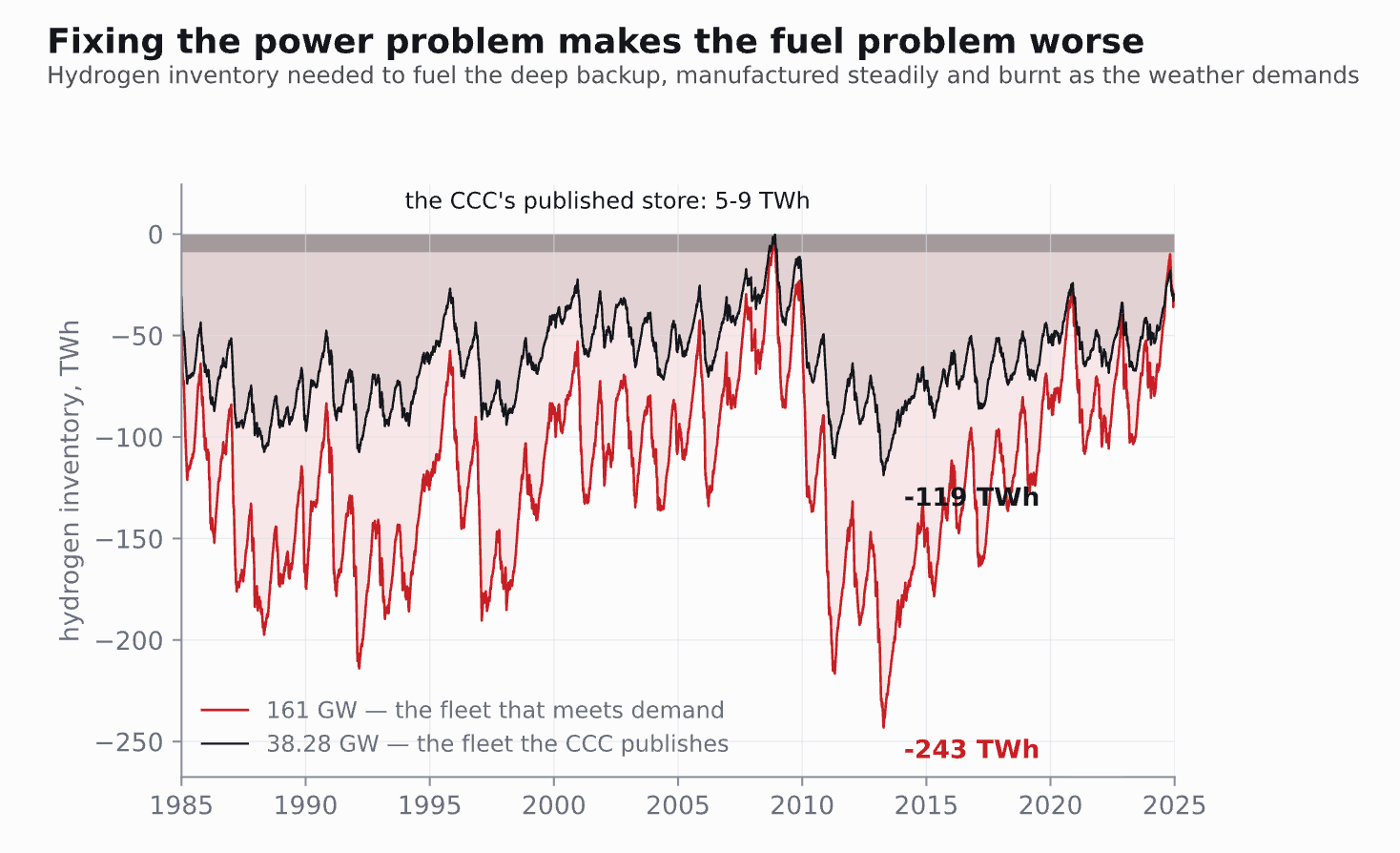
In a followup study, I work backwards from that shortfall to ask: what firm generation capacity would be necessary to (just) avoid blackout over a 40 year period? And if that generation capacity was fuelled by hydrogen, what size of store would be required. The results are, if anything, even more sobering.
Recall that the CCC specifies 38.28 GW of what it calls “low-carbon dispatchable” plant, and does not say what it burns — hydrogen, or gas with carbon capture, or some mixture; it records the question as unresolved. Alongside it the Committee publishes 5 to 9 TWh of hydrogen storage, the range existing precisely because the fuel question is open.
Run that fleet against the weather of 1985 to 2024 and ask what capacity would have been needed to serve every half-hour, and the answer is 161 GW. Granting it every advantage I could think of — including perfect foresight, so it husbands its storage into each lull instead of stumbling into it — the requirement falls to 93 GW, still two and a half times what the Committee has specified, and now a floor rather than an estimate, because there is nothing further to concede.
Take the pathway on its own terms, then, at the 161 GW it needs without any of those concessions. If that plant burns hydrogen it gets through 320 TWh of it a year, and the tank behind it has to hold 243 TWh to ride out the worst sequence of winters in the record. The Committee publishes 5 to 9 TWh — perhaps £2 to £4 billion of salt cavern. The tank the weather actually demands is closer to £110 billion, and it appears nowhere on any cost estimate I have seen.
NESO’s whistleblower called blackouts “an engineering certainty”. He was talking about the grid we already have. The one they’re planning for us is much, much worse.
My book The Energy Trap is published by Swift Press in September.
Another thing to say - and I experience this in my own work - the amount of data centre development currently in the pipeline is substantial.
It’s akin to a property developer gold rush. Maybe it’s just the end of the 18.6 year land speculation cycle, maybe it’s real.
But we’re talking minimum 100MW per site. And if there’s no power available then they’re considering building out prime generation (eg gas)
Whether these two could actually benefit the grid is another question. Traditional DC might work to tier 3 (99.98%) or 4 (99.995%) availability. AI DC might be more flexible in that regard. Not all AI, but some flexibility exists because outputs are not instantaneous an SC batch processing and training can go on hold. So my question would be “can these sites, once functioning, be curtailed to support grid stability?” It’s not ideal. And it’s not how I would have designed a grid. I would have installed far more firm power instead of wind and solar.
Now the next obvious question. “How much does it cost?” If you’ve invested billions in your AI DC GPUs, you don’t want them sitting around idle, unless someone pays you. Or unless you agreed to sign up to terms which meant the power was curtailable. So it comes down once more to NESO, to the DNO & TNO commercial contracts when offering DC sites with “firm power” and the repercussions of withdrawing.
Let’s say we have 50 AI DC sites of 100MW each, and they can wind down their GPUs, cooling systems etc when they get the NESO call. And they’re big enough to get that call. Let’s say they can reduce by 40%. That’s 4GW.
So lots still in play….and should keep us busy for years 😁
Certainly there are people in the UK with functioning vision. Why are they not involved in the process? Is it because "the powers that be" don't like what those with vision see?