
Doing your bit in the dark
The moon is now a load-management event.

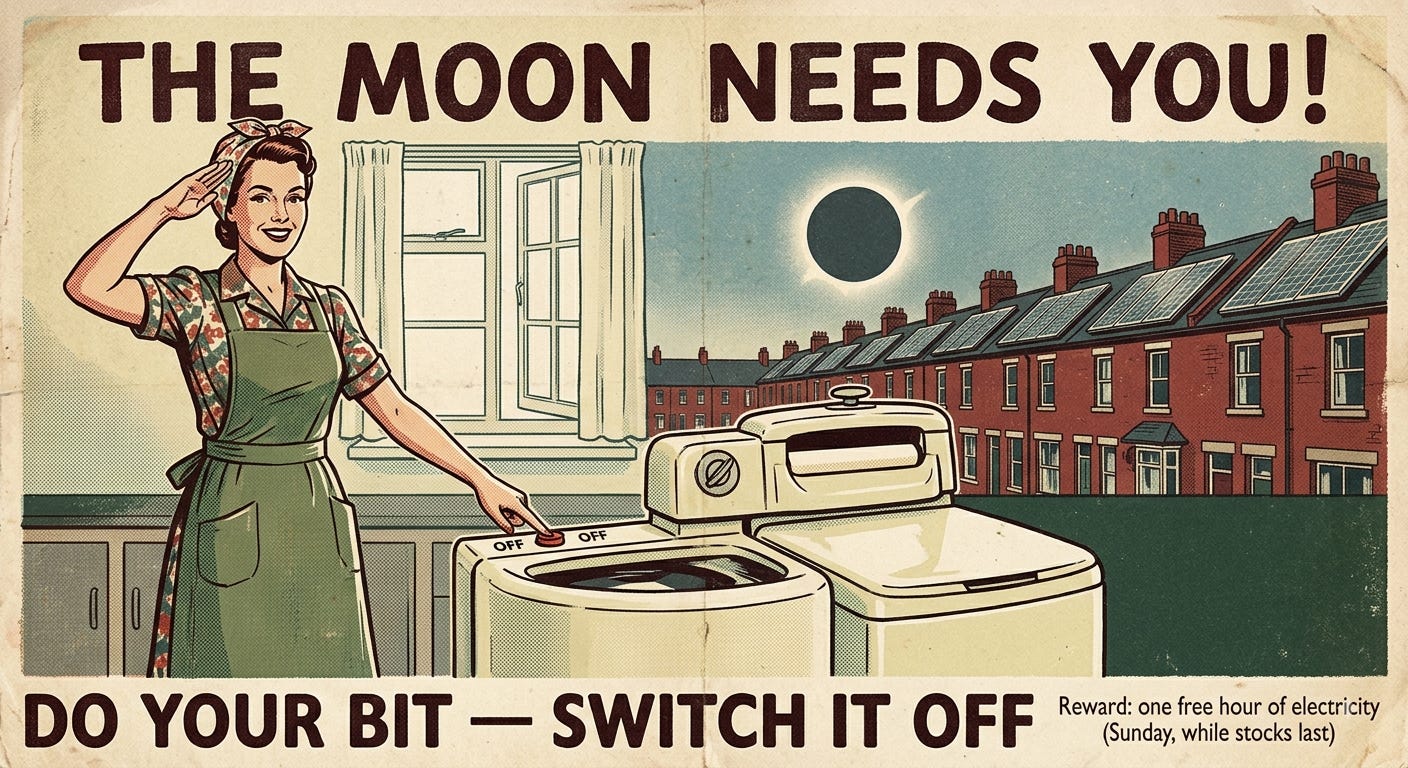
WHEN I was a boy, I was told there would be flying cars. Tonight, we are being told to turn our washing machines off because the sun is going behind the moon. This is what rationing looks like.
Be clear about what is not the embarrassing part. An eclipse is the most predictable event in nature — the Babylonians could forecast one, and an astronomer will tell you to the second when the shadow reaches each solar farm in Europe. The embarrassing part is that an electricity system which has known for centuries precisely when its fuel would be switched off still needed a margin notice about it. NESO issued one for this evening’s peak — no risk to supply, it stresses, merely the standard instrument. We have built a grid that takes the weather as an instruction, and this week the weather includes the moon.
Octopus Energy, to its credit, saw the marketing opportunity. Its Eclipse Power Down invites its more compliant customers to use less electricity than usual between six and eight this evening, the smart meter keeping score. The reward for going without on Wednesday is one hour of free electricity — on Sunday, in the daytime, when the grid is awash with the stuff and wholesale prices sag towards nothing. An ordinary household draws perhaps a third of a kilowatt-hour in a daytime hour: call it ten pence. To collect more you must cram the ironing, the dishwasher and a boil-wash into your appointed free hour — that is, build yourself a private demand spike to celebrate having flattened a public one. ‘Households can help reduce the need for gas power stations,’ says the company’s Chief Customer Officer, ‘and earn rewards for doing their bit.’ Doing their bit. The last time Britons were paid in coupons and told their small sacrifices were defeating a national emergency, the emergency was the Luftwaffe.
The word ‘flexibility’ is doing a lot of work in blurring two ideas here. Demand shifting is honourable and old: Economy 7 was paying people to heat bricks overnight fifty years ago, because the nuclear fleet ran regardless and the electricity was genuinely cheap. The wash still happens; you choose when; you end the day having done everything you meant to do. Curtailment is the other thing: the wash does not happen, you consume less, and the payment is for going without. The eclipse hour is dressed as the first. Its arithmetic — a few pennies for the compliant, at a time the system finds convenient — is a rehearsal for the second.
And the rehearsal has a production schedule. Last week NESO expanded the Demand Flexibility Service nationwide; the week before, DESNZ published draft licences for third parties to manage household heat pumps, car chargers and batteries remotely — applications from March 2027, binding from March 2028. The moon moves on tonight at two kilometres a second. The enforcement machinery being built around this evening’s little abstinence is designed to stay.
The Energy Trap: Why the Renewable Energy Transition Can’t Work — And What Can is published by Swift Press in September.*
What a different August it was in 1999- the eclipse was also on a Wednesday, 11th, but no exhortations not to use your washing machine, dishwasher etc. There was no thought back then ( by the ordinary person, at any rate) of voluntary rationing of power ( for now), people just enjoyed the marvel for what it was. The skies darkened, there was a distinct chill and the birds went quiet.
The papers informed that the next best eclipse would be 27 years away. We could hardly have envisaged the 'changes' in the energy system we are enduring in 2026, changes that are impacting power supplies to feed the behemoth project of Net Zero. Fires from solar panels on roofs, EV fires, and plug in solar panels to possibly cause more combustion!
The landscape has changed for ever as the march of wind turbines and the installation of solar panels continues unabated.
This is one of the most ludicrous and pathetic situations for Britain to be in. The real problem is that we have no reliable supply available for high energy users so they have all gone elsewhere. We cannot make steel, fertiliser or other things that require industrial heat. The grid is being constructed to be highly vulnerable by using solar and wind then and this an enormous problem. That notwithstanding the negative environmental consequences that such technologies bring with them.